
Ukrainian Veterinary Medicine on the Global Stage: The Experience of Resilience and Innovation from a Frontline Clinic in Sumy Presented at the WSAVA World Congress, Warsaw 2026.
The experience of Ukrainian veterinary medicine—which continues to evolve and implement innovations amidst the war—was showcased on the international scientific stage at the World Congress of the World Small Animal Veterinary Association (WSAVA), held in Warsaw from October 13–15, 2026.
For the Ukrainian veterinary community, participation in such international events is more than just an opportunity to exchange professional knowledge, learn about modern approaches to animal diagnosis and treatment, and build partnerships. It is also a chance to share with the world the Ukrainian experience of working under exceptionally difficult conditions, to demonstrate the professional resilience of veterinarians, and to show how wartime challenges serve as a catalyst for finding new solutions.
One such example was the participation of the "VetDopomoha" veterinary clinic from the city of Sumy in the scientific program of this year’s WSAVA Congress. The Ukrainian experience was presented in the form of a poster presentation focused on the use of artificial intelligence to ensure the operational resilience of a veterinary practice located in a frontline city.
Artificial Intelligence in Frontline Veterinary Practice: From Technology to Practical Tool
The poster presentation was titled: «Navigating Turbulent Environments: AI-Driven Operational Resilience and Resource Multiplication in a Frontline Veterinary Practice (Sumy, Ukraine)».
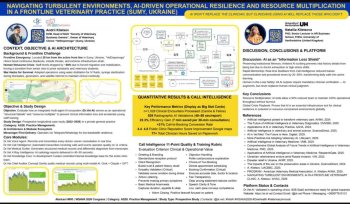
The subject of this research addresses one of the most pressing issues in modern veterinary medicine: how to ensure stable clinic operations, high-quality veterinary care, and the efficient use of resources when standard operating conditions are in a state of constant flux.
For veterinary facilities located near combat zones, daily operations entail additional risks and constraints. This necessitates adapting workflows to the security situation, managing human and material resources rationally, and maintaining the continuity of animal care-all while upholding appropriate professional standards. Under these circumstances, digital technologies take on particular significance. Artificial intelligence is viewed not as a trendy technological novelty or a purely theoretical experiment, but as a tool that can help the veterinary team organize their work more effectively, systematize information, optimize administrative processes, and support decision-making. This is precisely the concept of resource multiplication: through technology, the team gains the ability to make more effective use of their available time, knowledge, and professional potential.
At the same time, it is important to understand that artificial intelligence does not replace the veterinarian, their clinical experience, or their responsibility. Its value lies in supporting the specialist’s work, and the results generated by these technologies require professional verification. This is especially critical in medicine, where decisions directly impact the health and well-being of patients.
Operational Resilience: A Key Requirement for the Continuity of Veterinary Care
The concept of operational resilience takes on a special significance in wartime. It refers not only to a clinic’s ability to continue operating despite external circumstances, but also to its capacity to adapt internal processes, maintain effective teamwork, and find solutions amidst limited resources.
Ukrainian veterinarians demonstrate daily that professional responsibility does not vanish—even when their work is accompanied by air raid sirens, security threats, and unpredictable disruptions to everyday life.
For veterinary practices near the front line, it is essential not only to respond to immediate challenges but also to establish processes that ensure operational continuity across various potential scenarios. In this context, the implementation of digital tools can serve as a component of a broader resilience strategy. These tools help reimagine workflows, reduce the time spent on routine tasks, streamline information processing, and allow for a greater professional focus on the needs of patients.
The experience from Sumy is significant not only for Ukrainian clinics operating in frontline regions. It could also serve as a subject of study for the international veterinary community, which is seeking effective models for organizing medical care amidst crises, instability, and emergencies. At the same time, the practical outcomes of implementing such approaches must be evaluated based on concrete data. Determining the effectiveness, safety, and tangible benefits of artificial intelligence requires rigorous research support, systematic analysis, and verification of the results obtained.
International Scientific Dialogue and Collaboration with British Universities
An essential component in the development of innovations in veterinary medicine is the integration of practical experience with scientific research. Technological solutions must not only address the actual needs of clinical practice but also be grounded in evidence-based approaches, critical evaluation of outcomes, and an understanding of potential limitations.
International academic collaboration plays a particularly significant role in this project.
The authors extend special thanks to Nataliia Klietsova and the University of Hertfordshire for their scientific collaboration and support of this research work.
Another key aspect of this collaboration involves engagement with the academic community at the University of Surrey School of Veterinary Medicine and its innovation incubator, vHive.
Combining the expertise of practicing veterinarians with the research capabilities of a university environment creates a foundation for developing solutions that hold practical value-not only within a specific clinic but also within the broader professional context.
This approach allows the challenges of veterinary practice near the front line to be viewed not merely as a local issue, but as an opportunity to generate knowledge, experience, and technological solutions suitable for further study and adaptation in other settings.
In this context, international cooperation goes beyond a mere exchange of ideas. It offers an opportunity to combine diverse expertise, research approaches, and practical needs to find answers to the complex challenges facing modern veterinary medicine.
WSAVA: An International Platform for Professional Development
The WSAVA World Congress serves as a vital international platform for veterinarians, scientists, educators, and other professionals working in the field of animal health and welfare. Such events facilitate the dissemination of up-to-date knowledge, the discussion of new scientific findings, the development of professional competencies, and the formation of international partnerships.
According to organizers and participants, this year’s congress in Warsaw brought together members of the veterinary community from across the globe. Figures provided by the organizers and participants include over 7,000 delegates, representation from 103 countries, 12 parallel scientific tracks, and 156 professionals from Ukraine.

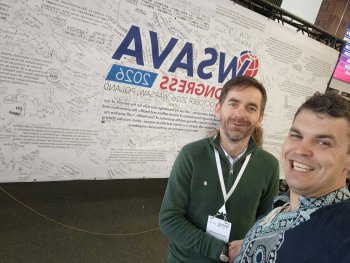
These figures demonstrate the scale of professional dialogue and the significant interest in the development of veterinary medicine at an international level.
For Ukrainian specialists, participation in the congress holds particular value. It offers an opportunity not only to become familiar with international standards and new technologies but also to share their own experience—experience forged under unique and exceptionally challenging circumstances.
Ukrainian veterinary medicine today is about more than just adapting to new challenges. It also involves seeking innovative solutions, fostering professional collaboration, and contributing to the international discourse on the future of the field.
Ukrainian Experience Worthy of International Attention
A particular source of pride for the "VetDopomoha" team was the presentation of the clinic’s experience within the congress’s official scientific program. This achievement holds significance that extends beyond a single veterinary practice. It demonstrates that Ukrainian professionals continue to work, develop their professional competencies, and contribute to shaping the international scientific agenda—even amidst a full-scale war.
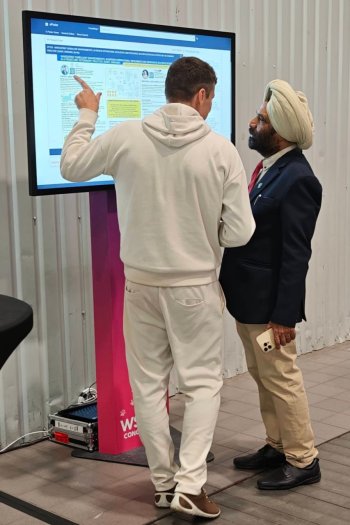
The experience of a frontline clinic demonstrates that innovations can emerge not only within large scientific centers or technology companies. They can take shape directly through practical, day-to-day work-in environments where one must constantly find ways to use resources efficiently, support the team, and ensure care for patients.
At the same time, sharing this experience internationally opens doors for further research into its outcomes, professional dialogue, and the identification of partners to help develop new solutions.
The Future of Veterinary Medicine: A Synthesis of Professionalism, Science, and Technology
Modern veterinary medicine is evolving rapidly. Digitalization, artificial intelligence, the development of evidence-based approaches, and international collaboration are gradually becoming key components of the professional landscape.
However, the true value of innovations lies not merely in the existence of new technologies, but in their ability to address the actual needs of professionals, improve workflow organization, and maintain a high standard of care for animals.
That is precisely why the experience of a veterinary clinic in Sumy deserves attention. It raises an important question: how can veterinary practice be made more resilient, efficient, and better prepared for crises—without losing sight of its core mission: professional responsibility for the health and well-being of animals? For the Ukrainian veterinary community, such initiatives demonstrate how local, practical experience can contribute to the broader international professional dialogue. For the global community, meanwhile, they offer a glimpse into how professionals pursue innovation under conditions that demand exceptional flexibility, resilience, and a strong sense of responsibility.
Ukrainian veterinary medicine continues to develop, collaborate globally, and assert itself confidently on the international stage.
Author: Andrii Klietsov, Head of the Board of the NGO "Society of Veterinary Business Owners" (NGO SVBO).

